Aluminum alloy brackets + concrete foundation = mature solution
But the solution doesn't equal the result; the installation process is the true test of long-term benefits.
As a supplier of aluminum alloy photovoltaic brackets, we answer the same question from our customers every day: "Can your brackets really last 25 years?"
Our answer has always been honest: Yes, but only if installed correctly.
Aluminum alloy brackets + concrete foundations are a mature solution proven by numerous ground-mounted power plants worldwide. Their material properties, corrosion resistance, and structural strength are sufficient to support stable operation for over 25 years. However, even the best product will have a significantly reduced lifespan if three key details are overlooked during installation.
Today, we won't talk about selling products, but rather, from a supplier's perspective, we'll clarify these three most easily overlooked installation points. This isn't about shirking responsibility, but about ensuring that every penny you invest yields tangible long-term benefits.
I. Concrete Curing: Not Just "Dry and It's Done"
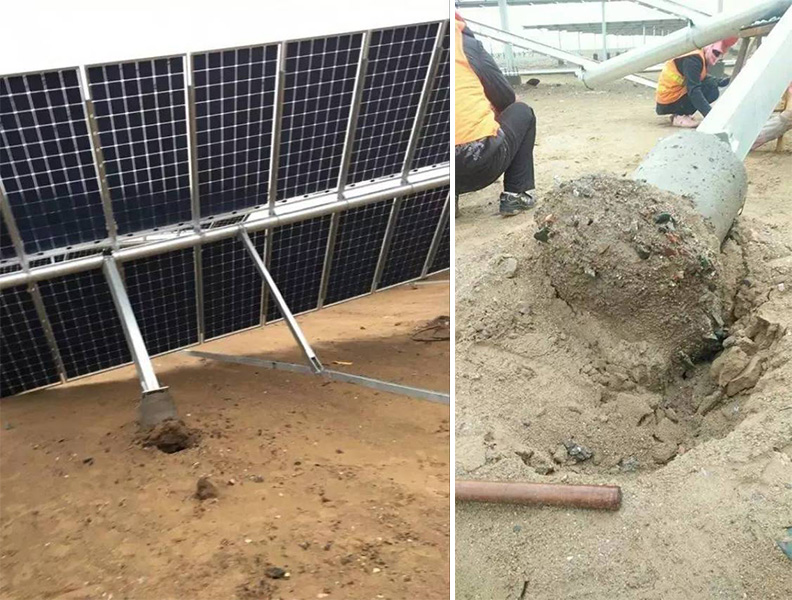
We often encounter this situation: projects are rushing to meet deadlines, and the construction team erects the scaffolding just two or three days after the concrete foundation is poured. It feels hard to the touch, but the internal strength is far from meeting the standards.
What's the problem?
The strength gain of concrete is a chemical reaction that requires sufficient moisture and temperature. National standards clearly stipulate that scaffolding should not be installed or loads applied to concrete before its strength reaches 70% of the design value.
At normal temperatures (around 20℃), this time is approximately 7-14 days. The lower the temperature, the longer the time. If loading is applied before proper curing, micro-cracks invisible to the naked eye will form inside the foundation. These cracks will gradually widen under subsequent wind vibration and snow loads, eventually leading to foundation loosening, scaffolding tilting, or even overall instability.
As a supplier, our recommendations are:
• Specify the curing period in the contract: Require the construction party to provide a concrete strength test report confirming that it has reached at least 70% before installing the scaffolding.
• On-site observations: Is the foundation surface covered with moisture-retaining material (film, geotextile)? Is it regularly watered? Are there insulation measures in place for winter construction?
• Do not easily agree to "shorten the curing period": Any request to expedite the construction period should be confirmed in writing by a structural engineer.
A good foundation is fundamental to the stability of the support system. This cannot be rushed.
(The photo is from the 搜狐)
II. Anti-corrosion layer protection
Many customers choose aluminum alloy supports because they are "rust-free." However, "rust-free" is not because it is inherently corrosion-resistant, but because it has a dense protective film of alumina on its surface.
How thick is this film? After anodizing, it is about 15 micrometers thick, thinner than a human hair. It is the "skin" of the aluminum alloy; once scratched, the underlying aluminum material will be exposed to the air and slowly corroded.
What operations during installation can ruin it?
• Gas cutting to enlarge holes: If the hole positions don't match on-site, grab an oxygen-acetylene torch and start burning. High temperatures instantly destroy the oxide film, and the burned areas become brittle, making them extremely prone to breakage later.
• Arbitrary cutting: Materials were not prepared according to the drawings, and ordinary saw blades were used for on-site cutting. The cut surfaces were left unprotected, completely exposed.
• Violent impact: The bracket was struck hard with a hammer, resulting in surface scratches and dents.
• Direct contact with iron parts: Ordinary carbon steel bolts and washers were used, causing "galvanic corrosion" with the aluminum alloy, accelerating the decay of the aluminum parts.
As a supplier, our recommendations are:
No gas cutting or electric welding: This is a red line. Aluminum alloy brackets can only be machined, not thermally cut.
• Check the material of connecting parts: All bolts, nuts, and washers must be stainless steel (SUS304 or higher). A simple way to determine this is with a magnet—stainless steel has virtually no magnetism.
• Inspect the surface upon arrival: The surface of the aluminum alloy profiles should be uniform, smooth, and free of obvious scratches. If there is serious damage during transportation, it should be replaced immediately.
• Highly Corrosive Environments: For projects near coastal areas or chemical plants, it is recommended to add a fluorocarbon coating on top of the oxide film, giving the support structure two layers of protection.
Protecting this "skin" is crucial for ensuring the aluminum alloy truly remains rust-free for 25 years.
III. Waterproofing and Drainage
This applies to both rooftop and ground-mounted solar power systems. While the problems manifest differently, the underlying issue is the same—long-term contact between water and the foundation is a chronic problem.
Rooftop Solar Power Systems: Damaged Waterproofing Layers Have Serious Consequences.
Many commercial and industrial solar power installations are mounted on corrugated steel roofs or flat concrete roofs. Drilling and installing weights are inevitable during construction. If the original waterproofing layer is damaged and not properly repaired, the result is: heavy rain outside, light rain inside.
Once leaks occur, repair costs are 3-5 times the initial construction cost, and disputes are often unresolved.
(The photo is from the SOLARZOOM)
Our Recommendations:
• Prioritize Non-Destructive Fixing: Concrete ballast foundations (where counterweights are placed directly without drilling) are the safest option.
• When drilling is necessary, ensure three layers of sealing: waterproof sleeve + polyurethane sealant + additional roofing membrane; all three are essential.
• A water tightness test must be conducted after completion: fill the flat roof with water for 24 hours; acceptance is only possible if no leakage is confirmed.
• Clearly define waterproofing responsibility in the contract: the contractor shall bear all repair costs and compensation for losses caused by construction.
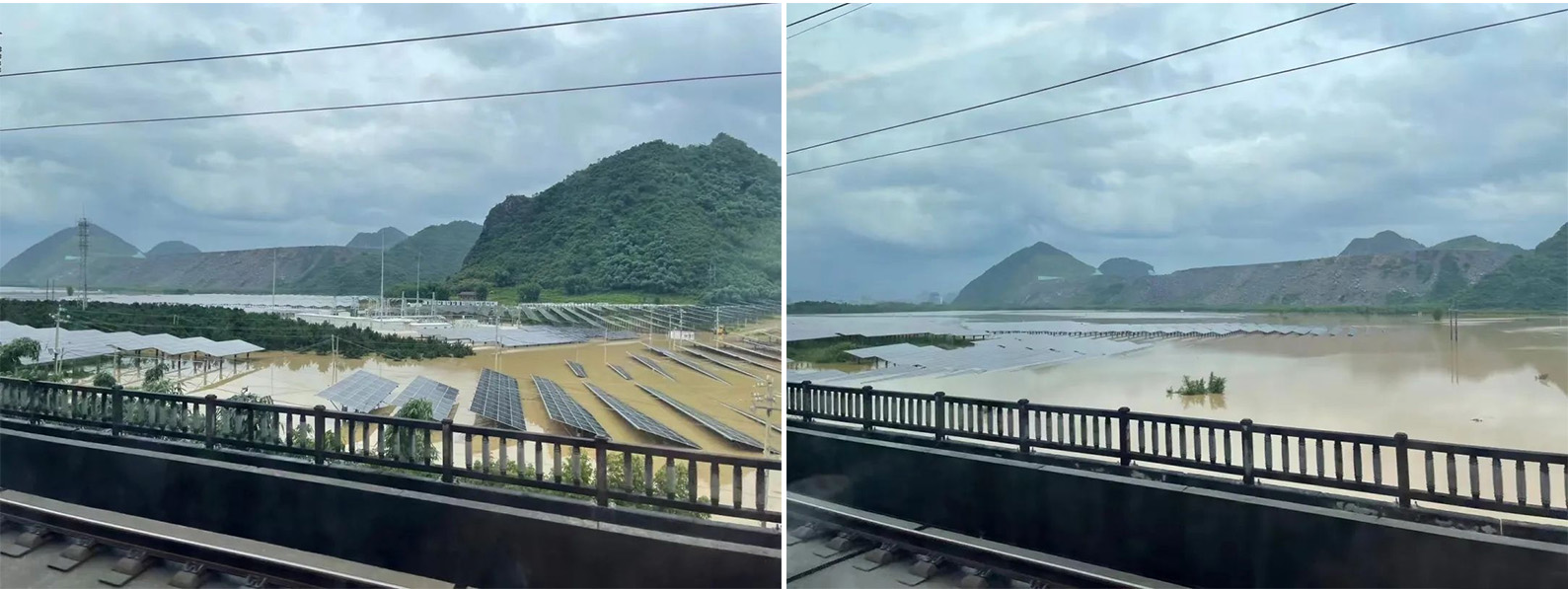
Ground-mounted power stations: Poor drainage halves the lifespan of the foundation due to water immersion. While ground-mounted power stations don't have the problem of "leaking into other people's homes," long-term water immersion of the foundation is equally fatal. Accumulated water softens the surrounding soil, reducing its bearing capacity; in cold regions, repeated freeze-thaw cycles can even cause the foundation to crack.
Our recommendations:
• Initial site survey should consider the terrain: avoid low-lying areas and seasonal floodplains as much as possible.
• The site must have drainage design: the slope should be no less than 0.3%, and open ditches or underground pipes should be installed around the array to divert rainwater.
• If the site has poor drainage conditions: it is recommended to use pile foundations, raising the support structure to at least 500mm, instead of relying solely on concrete extended foundations. • Maintenance and Inspection: Don't forget to check: Clean the drainage ditches quarterly, and check the area around the foundation for standing water before and after the rainy season.
Keep water and the foundation as far apart as possible.
Summary
We provide high-quality products, but we also ask you to find the right construction team.
As a support system supplier, we guarantee that the material of the aluminum alloy profiles, the thickness of the oxide film, the grade of the connectors, and the load-bearing capacity of the structure all meet national standards, sufficient to support a service life of over 25 years.
| Key Aspects |
Core Requirements |
| Concrete Curing |
Installation only after strength reaches ≥70% of design value |
| Anti-corrosion Protection |
No gas cutting; use of stainless steel fasteners |
| Waterproofing and Drainage |
No leaks in the roof; no standing water on the ground |
However, we cannot control on-site concrete curing, anti-corrosion layer protection, and waterproofing and drainage construction. These aspects require the joint efforts of you, the construction team, and us.
Finally, a sincere word: Choosing good support systems is only the first step; choosing a reliable installation team is equally important. If you are interested in our products, we can provide detailed technical specifications and installation guidelines. If you already have a construction team, you can also forward this guide to them—let everyone know that these details cannot be overlooked.
A power station's 25 years of success begins with laying a solid foundation and protecting every support system.


 en
en fr
fr de
de zh-CN
zh-CN ru
ru es
es pt
pt ja
ja ko
ko ar
ar