Leave A Message
If you are interested in our products and want to know more details,please leave a message here,we will reply you as soon as we can.



This global achievement is inseparable from the continuous rollout of new projects around the world. For example, in 2022, the Solar First Group continued its efforts and successfully completed the grid connection of multiple photovoltaic power station projects of various types in several countries, including China, Japan, Canada, Malaysia, and Indonesia. These projects cover a wide range of application scenarios, from large-scale ground-mounted power stations to commercial and industrial rooftops, providing strong support for the clean energy transition in their respective host countries. At the same time, they have directly contributed to the historic milestone of global PV installations exceeding 1 terawatt (TW), becoming an indispensable part of the worldwide energy transition wave.

( Solar First's global photovoltaic projects )
In 2021, as photovoltaic power generation efficiency improved and cost‑effectiveness became more prominent, the installed capacity of residential PV (mainly rooftop systems) set a new growth record, while commercial and industrial PV capacity also showed a marked increase.
Currently, the total amount of global photovoltaic power generation is theoretically sufficient to meet the electricity demand of nearly all European countries — although constrained by bottlenecks in transmission and storage, it is still not enough to shake the dominant position of traditional energy sources.
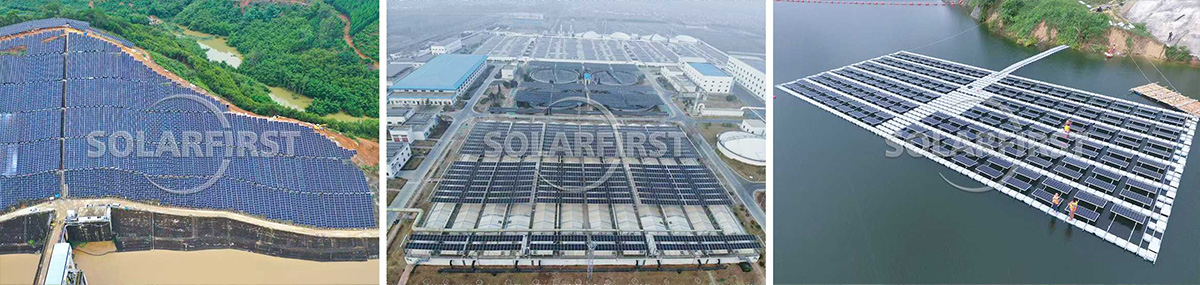
( Solar First's global photovoltaic projects )
According to data estimates from BloombergNEF, global PV installed capacity surpassed 1 terawatt (TW) last week. This means that "we can officially use terawatt (TW) as the unit for measuring PV capacity."
Take Spain as an example. The country enjoys an average of about 3,000 hours of sunshine per year, which in theory could generate 3,000 terawatt‑hours (TWh) of solar power. That figure is close to the total electricity consumption of major European countries, including Norway, Switzerland, the United Kingdom, and Ukraine — approximately 3,050 terawatt‑hours (TWh). However, the reality is that currently only about 3.6% of the European Union's electricity demand is met by solar energy, while in the UK the figure is slightly higher at approximately 4.1%.
BloombergNEF predicts that, based on current market trends, solar energy will account for 20% of Europe's energy mix by 2040.
According to data from BP's "Statistical Review of World Energy 2021", 3.1% of the world's electricity in 2020 came from photovoltaic generation. Given that PV installed capacity rose by 23% last year, it is expected that this share will approach 4% in 2021. The growth of PV generation is mainly driven by China, Europe, and the United States — the combined installed capacity of these three regions accounts for more than half of the global total, jointly leading the critical stage of the global energy transition.
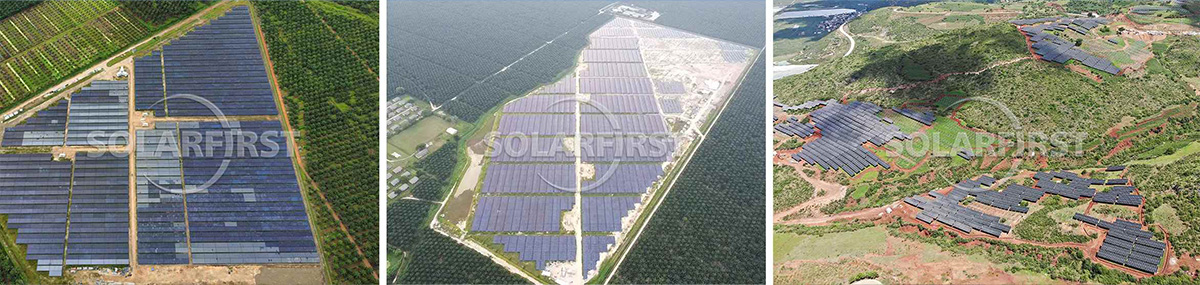
( Solar First's global photovoltaic projects )

 en
en fr
fr de
de zh-CN
zh-CN ru
ru es
es pt
pt ja
ja ko
ko ar
ar