Leave A Message
If you are interested in our products and want to know more details,please leave a message here,we will reply you as soon as we can.


The BIPV (Building Integrated Photovoltaic) sunroom products developed by Solar First Group have made a grand entrance in Japan, drawing widespread attention.
Following the product launch, Japanese government officials, business leaders, and photovoltaic industry professionals flocked to the installation site for inspections and investigations.
This product was innovatively created by the R&D team of Solar First. It adopts vacuum insulated Low-E glass technology and perfectly integrates renewable energy photovoltaic power generation into the sunroom structure, successfully building a model of "Net Zero Energy Building (ZEB)".
Core patent technologies
Solar First has filed multiple patent applications for the BIPV technology used in this product. Details are as follows:
High praise from Japan
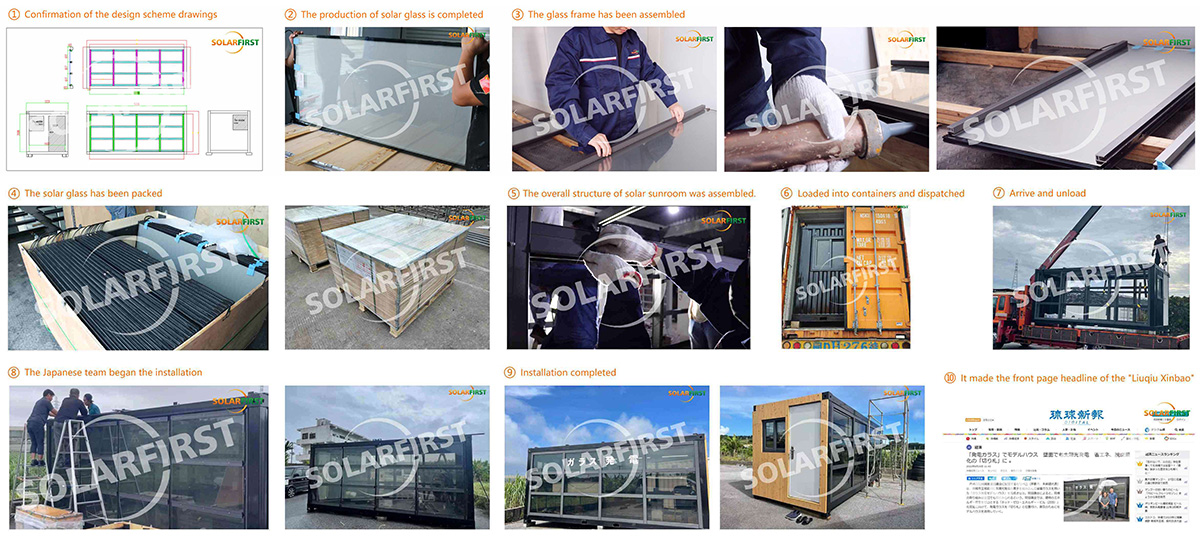
Front‑page highlights of the Ryukyu Shinpo
Association members (the representative of Naha City and President Mr. Zhu) built a "power‑generating glass" model house using laminated glass with power generation capability. According to the association, this is the first such structure realized in Japan. The association regards this solar glass as the "trump card" for advancing zero‑energy buildings.
A Zero Energy Building (ZEB) refers to a building that maintains a comfortable indoor environment while maximizing energy conservation and reducing consumption, achieving self‑sufficiency in building energy. Under the global trend toward decarbonization, the importance of ZEB is becoming increasingly prominent.
The roof and walls of this model house are fully covered with Low‑E laminated glass that integrates heat insulation, heat retention, and power generation. The roof has a light transmittance of 0%, while the walls have 40% transmittance. The photovoltaic system has an installed capacity of 2.6 kW, and the indoor area is equipped with air conditioners, a refrigerator, lamps, and other facilities.
Solar glass can be customized with textures such as wood grain. President Zhu stated that, in the context of rising electricity prices, such designs are both environmentally friendly and economical, while also meeting requirements for heat insulation and preservation.
The association disclosed that eight buildings in Okinawa Prefecture are planned to be transformed into ZEBs. Zukeran Tyojin, the association’s representative, pointed out that it is difficult to achieve ZEB by installing photovoltaic panels only on the rooftops of urban residential buildings – effective use of walls is crucial. He called on the public to visit the model house and develop a positive understanding of ZEB.
Project milestones

 en
en fr
fr de
de zh-CN
zh-CN ru
ru es
es pt
pt ja
ja ko
ko ar
ar