Leave A Message
If you are interested in our products and want to know more details,please leave a message here,we will reply you as soon as we can.



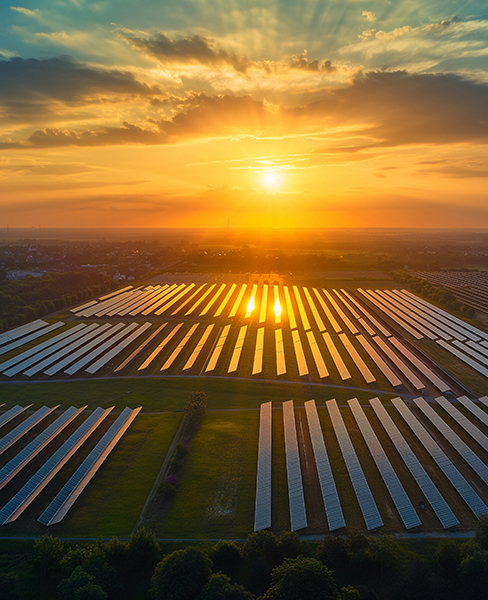
Photovoltaic communication base stations refer to a new type of infrastructure that uses solar photovoltaic power generation to provide all or part of the power for communication equipment (such as 4G and 5G base stations). Against the backdrop of the dual goals of "carbon peaking" (i.e., carbon neutrality) and the high energy consumption of 5G networks, it is becoming a key path for the green transformation of the communications industry.

Product Description
The photovoltaic telecommunications base station power supply system is specially designed for harsh environments. It provides stable pure sine wave output through DSP intelligent inverter technology and is suitable for highly sensitive loads such as communication base stations.
The dual-screen display enables real-time monitoring of the operation status, and the programmable charging parameters meet the requirements of special scenarios such as mining areas and border defense.
Battery password protection and multiple protection mechanisms ensure the reliable operation of telecommunications facilities in remote areas 24/7.
Core technology
• DSP intelligent control inverter technology: It uses digital signal processors to achieve high-precision electrical energy conversion
• Pure sinusoidal AC output: Strong load adaptability, compatible with various communication devices
• Dual-display monitoring system: LCD+LED dual-screen display, providing real-time feedback on the operating status and alarm information of the equipment
• Programmable charging control: Supports customized charging parameters to meet the needs of special scenarios
Safety protection system
• Output overload protection
• Multi-level parameter protection of battery (supporting password lock)
• Automatic protection mechanisms such as abnormal temperature
Parameters
| System power | 10KW | 15KW | 20KW | 30KW | 50KW |
| Solar panel power | 420W | ||||
| Number of solar panels | 24 PCS | 36 PCS | 48 PCS | 72 PCS | 120 PCS |
| Photovoltaic DC cable | 1 SET | ||||
| MC4 connector | 1 SET | ||||
| DC combiner box | 1 SET | ||||
| Controller | 216V50A | 216V75A | 216V100A | 216V100A | 348V150A |
| Lithium battery/Lead-acid battery(Gel) | 216V | 348V | |||
| Battery capacity | 200Ah | 300Ah | 400Ah | 600Ah | |
| Inverter AC input side voltage | 304-456V | ||||
| Inverter AC input side frequency | 45-65Hz | ||||
| Inverter off-grid rated output power | 8KW | 12KW | 16KW | 24KW | 40KW |
| Maximum output apparent power on off-grid side | 10KVA 10min | 15KVA 10min | 20KVA 10min | 30KVA 10min | 50KVA 10min |
| Rated output voltage on off-grid side | 3/N/PE,380/400 | ||||
| Rated output frequency on off-grid side | 50Hz | ||||
| Working temperature | 0~+40*C | ||||
| Cooling method | Air-cooling | ||||
| AC output copper core cable | 1 SET | ||||
| Distribution box | 1 SET | ||||
| Auxiliary material | 1 SET | ||||
| Photovoltaic mounting type | Aluminum /Carbon steel mounting (one set) | ||||
Advantages
▪ High Efficiency and Energy Saving:
The system adopts "direct DC power supply" technology, allowing the DC power generated by photovoltaics to directly power communication equipment that also uses DC power, eliminating multiple AC-DC conversion steps and thus reducing energy loss.
▪ Intelligent and Flexible:
The intelligent control system can sense the power demand of the base station in real time, achieving "on-demand power supply." The system has broad compatibility and can be adapted to different brands and models of communication power systems. Simultaneously, the modular design makes system expansion and maintenance more convenient.
▪ Stable and Reliable:
The system supports multiple energy inputs, including photovoltaics, energy storage, and mains power, and can achieve millisecond-level seamless switching between various energy sources, ensuring uninterrupted operation of communication equipment. The controller has multiple circuit protection functions, including backflow prevention, short circuit protection, and overvoltage protection.
▪ Environmentally Friendly and Carbon Reduction:
As a clean energy solution, photovoltaic power supply does not produce noise or pollution emissions. Applying photovoltaic power generation in communication base stations helps reduce carbon emissions.
Applicable Scenarios
▶ Remote areas and areas without mains power:
Such as mountainous regions, deserts, and islands, where laying power lines is costly or impractical, photovoltaic (PV) communication base stations are an ideal power supply solution.
▶ Areas with unstable mains power:
For areas with unstable grid voltage or frequent power outages, PV systems can serve as supplementary or backup power, improving the reliability of base station power supply.
▶ Energy-saving retrofitting of urban 5G base stations:
For urban 5G base stations with high power consumption, adding PV systems can achieve "photovoltaic-electric complementarity," effectively reducing operating electricity costs and carbon emissions.
▶ Special industry communication sites:
Such as forest fire monitoring stations, oil/gas pipeline monitoring stations, and communication relay stations along highways.
Important Notes:
▪ Preliminary Survey and Design:
Before project construction, a detailed assessment of the site's solar resources and load power consumption is required. The installation location of the photovoltaic panels must ensure unobstructed sunlight during critical periods of sunshine (e.g., 9:00 AM to 3:00 PM).
▪ Capacity Matching and Safety:
The system design must reasonably match the capacity of the photovoltaic panels with the battery capacity, ensuring power supply during consecutive cloudy or rainy days while also considering economic efficiency. Simultaneously, proper lightning protection and grounding measures must be implemented to ensure the safety of equipment and personnel.
▪ Installation and Operation & Maintenance:
During installation, ensure the photovoltaic panel junction box faces downwards to prevent rainwater infiltration. In areas with high dust levels, the surface of the photovoltaic panels must be cleaned regularly; otherwise, dust accumulation may lead to a 15%-30% decrease in power generation efficiency. Furthermore, regular inspection using an infrared thermal imager can prevent damage to the photovoltaic panels due to hot spot effects.
Summary
Photovoltaic communication base stations are a mature solution integrating clean energy and communication technologies. Through the coordinated operation of photovoltaic modules, intelligent controllers, and energy storage systems, they provide reliable, efficient, and environmentally friendly power for communication base stations. This system is not only suitable for solving power supply problems in remote areas but also provides a feasible path for the green and low-carbon transformation of urban communication infrastructure. With continuous technological advancements and cost optimization, photovoltaic communication base stations are expected to play an increasingly important role in future communication networks.
Solar First Project Reference
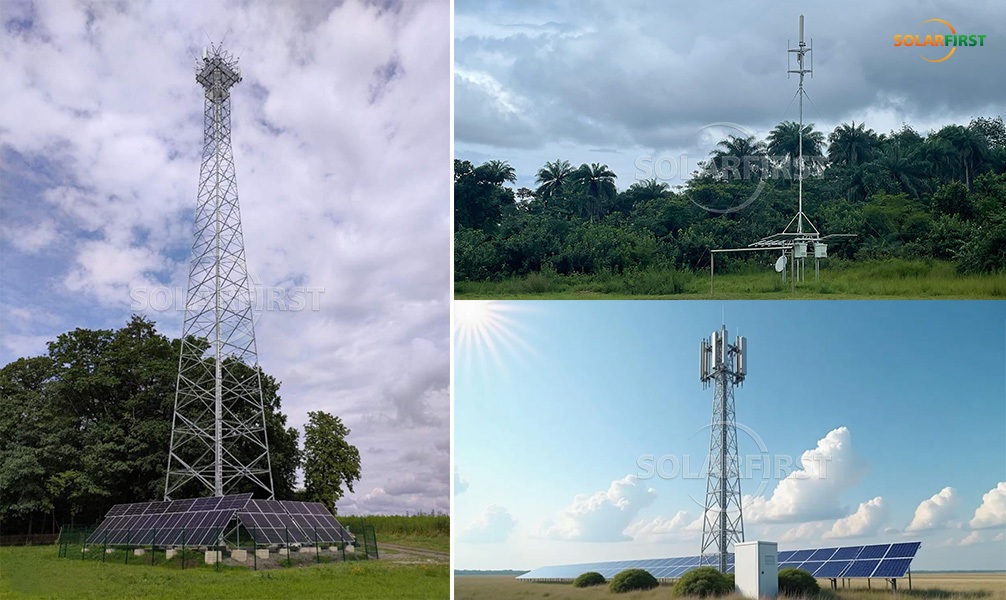
Photovoltaic communication base stations refer to a new type of infrastructure that uses solar photovoltaic power generation to provide all or part of the power for communication equipment (such as 4G and 5G base stations). Against the backdrop of the dual goals of "carbon peaking" (i.e., carbon neutrality) and the high energy consumption of 5G networks, it is becoming a key path for the green transformation of the communications industry.
Read More
 en
en fr
fr de
de zh-CN
zh-CN ru
ru es
es pt
pt ja
ja ko
ko ar
ar